


A family of four—two parents and two children under twelve—can obtain Vanuatu citizenship together through the Development Support Program (DSP), provided they meet designated dependent definitions, supply apostilled relationship documents and clear enhanced due diligence for all applicants aged sixteen and over. Here’s what matters: the Vanuatu Citizenship Commission reviews applications submitted through licensed agents only, with processing typically completed within sixty to ninety days once all documents are verified. That timing window is real—file in January, expect your decision (and passport) by April at the earliest.
Get a Free Consultation


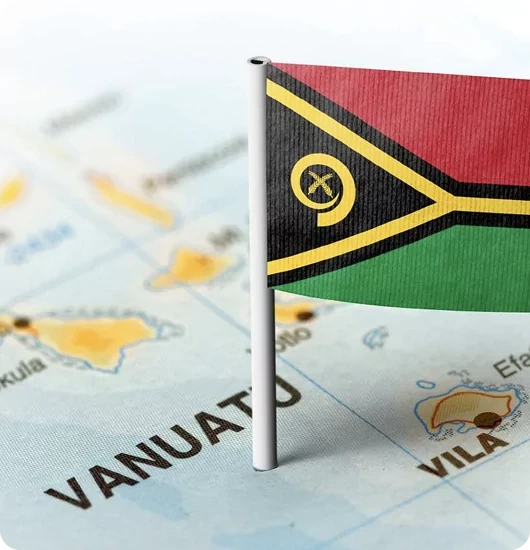
The Citizenship Act [CAP.112] PART 3 and DSP Regulations name four categories of dependent family members: legally married spouse, biological or legally adopted children under eighteen, financially dependent children aged eighteen to twenty-five enrolled in full-time tertiary education, and financially dependent parents aged fifty or older. Each carries distinct documentary requirements, administered by the Department of Immigration and Passport Services.
Spouses qualify automatically when the marriage predates the citizenship application and remains legally valid. Common-law partners and fiancés do not qualify—DSP Regulations require formalised civil or religious marriage ceremonies recognised in the couple’s country of residence.
Children under eighteen qualify as dependents without additional proof of financial dependency, provided they remain unmarried at application. Biological children require apostilled birth certificates listing the principal applicant as parent; adopted children require final adoption orders from a competent court, also apostilled and translated into English.
Young adults aged eighteen to twenty-five may qualify if they meet two cumulative conditions: they depend financially on the principal applicant and maintain full-time enrolment in a recognised tertiary institution. The Citizenship Commission requires official letters from universities or colleges confirming current enrolment status, academic year dates and expected graduation, plus bank statements or receipts showing the principal applicant covers tuition, accommodation and living expenses. Employment income earned by the dependent adult child typically disqualifies them unless the income remains below subsistence levels and the principal applicant still provides the majority of financial support.
Parents aged fifty or older qualify when they depend financially on the principal applicant for housing, medical care and daily living expenses. The Commission requires bank statements, utility bills in the applicant’s name showing the parent’s residence address, and affidavits declaring the parent has no independent income sufficient for self-support. Parents under fifty cannot be included under any circumstances—this age threshold has remained unchanged as of early 2026.
Recent marriages receive heightened scrutiny during due diligence, particularly when the marriage date falls within twelve months before application submission. The Financial Intelligence Unit (FIU) cross-references marriage dates with citizenship application dates, requests wedding photographs, joint bank account statements and evidence of cohabitation such as shared lease agreements or utility bills. Marriages of convenience designed solely to include an ineligible individual risk rejection and potential permanent ineligibility. Genuine recent marriages accompanied by comprehensive relationship evidence pass due diligence successfully, though processing may extend by two to three weeks while investigators verify authenticity.
Children qualify automatically until their eighteenth birthday. Once a child turns eighteen, qualification continues only if the child enrols in full-time tertiary education and remains financially dependent on the principal applicant—casual part-time employment does not disqualify, but full-time work income exceeding living costs does. At age twenty-five, eligibility ceases permanently regardless of education or financial circumstances.
Children born after the principal applicant receives citizenship can be registered separately as citizens by descent under different provisions of the Citizenship Act, avoiding a fresh DSP application. This route requires only proof of the parent’s Vanuatu citizenship, the child’s birth certificate, and a registration fee processed through the Department of Immigration and Passport Services.
Parents aged fifty or older qualify when evidence confirms they depend financially on the principal applicant. Acceptable evidence includes bank transfers from the applicant to the parent, utility bills in the applicant’s name for the parent’s residence, medical invoices paid by the applicant, and statutory declarations witnessed by a notary public or solicitor confirming the parent lacks independent income sufficient for self-maintenance.
Parents under fifty cannot be included as dependents under current DSP Regulations, even with proof of complete financial support. A parent aged forty-eight providing care for the applicant’s minor children, living in the applicant’s household and wholly supported financially, still does not meet the regulatory age threshold.
Ten years of continuous lawful residence in Vanuatu immediately preceding your application is the standard threshold. You’ll need to show ties to the community: employment, business activity, property ownership or long-term rental, references from Vanuatu citizens or established residents confirming integration. Children accompanying you must meet the same residence threshold unless they were born in Vanuatu to resident parents—a separate provision lets them skip the decade requirement.
Marriage to a Vanuatu citizen shortens the path. Five years of marriage plus residence in Vanuatu during that period, supported by a statutory declaration from your citizen spouse confirming the relationship is genuine. Due diligence is lighter than DSP screening but still includes criminal-record checks and verification that the marriage wasn’t contracted solely to obtain citizenship.
Indigenous ni-Vanuatu ancestry bypasses residency entirely. You’ll need an original birth certificate from the Department of Immigration and Passport Services showing at least one parent of indigenous ni-Vanuatu ancestry, corroborated by identity documents or family records tracing lineage. The Vanuatu Citizenship Office maintains genealogical records and assists applicants, but you carry the burden of proof.
Here’s the practical catch: each family member’s application is assessed individually. A principal applicant meeting residence requirements doesn’t automatically qualify a spouse or dependent children unless they also resided in Vanuatu for the required period. For families relocating to pursue naturalization, this means a collective long-term commitment—a very different undertaking than the DSP’s no-residency model.
All citizens—whether you obtained citizenship through DSP, naturalization, or descent—hold identical rights. Family members included in a DSP application gain full citizenship, not a derivative or conditional status. It’s permanent, inheritable, and cannot be revoked except in fraud cases during application.
Your passport opens 130+ countries and territories without advance visas: the United Kingdom (six months), the European Union Schengen Area (ninety days in any 180-day period), Russia (ninety days), Singapore (thirty days), Hong Kong (ninety days). Commonwealth membership also means you may apply for residence permits, business licences, and employment in jurisdictions offering preferential treatment to Commonwealth citizens.
Vanuatu’s territorial tax system is straightforward. No personal income tax, no capital-gains tax, no inheritance tax, no wealth tax on worldwide income—whether you’re a resident or not. Citizenship doesn’t impose tax residency; you can hold a passport and live elsewhere, paying tax only where you actually reside according to that country’s rules. United States citizens get no relief here—the US taxes citizens regardless of where they live or what other passports they hold.
Practically, a second passport buys redundancy and mobility. Your children can study abroad without visa friction. During political or economic instability in your country of origin, you have an exit option. Families can relocate quickly if circumstances demand. Vanuatu imposes no minimum stay; you’re not obliged to visit, reside, or invest further post-citizenship.
Property ownership becomes simpler for citizens (though foreigners may already acquire long-term leaseholds). After six months of continuous residence, you gain voting rights; after ten years of citizenship, you may stand for public office, though few DSP families pursue politics.
Citizen children enrol in public schools and compete for government tertiary scholarships covering university study in Australia, New Zealand, and Fiji under regional cooperation agreements. Scholarships are merit-based but require Vanuatu citizenship to apply.
Children born to a Vanuatu citizen parent after citizenship is granted automatically inherit Vanuatu citizenship by descent. This inherited citizenship passes to subsequent generations provided at least one parent holds Vanuatu citizenship at each child’s birth—expanding your family’s citizenship portfolio without additional DSP applications.
Government contributions follow a tiered structure set by regulation—these rates don’t move. A single applicant pays $130,000. A married couple without children contributes $150,000. A married couple with one child under eighteen pays $185,000, which is the most common family structure and serves as the baseline for calculating additional dependents.
Each additional child beyond the first costs $15,000 more. Two children: $200,000 total. Three children: $215,000. Four children: $230,000. The definition of “dependent” includes minor children, adult children aged eighteen to twenty-five enrolled full-time in education and financially reliant on the parents, and parents over fifty who depend on the applicant financially.
Separate from the contribution itself, due diligence fees run $5,000 per person aged sixteen and over. For a family of four with parents and two children (ages fourteen and seventeen), due diligence comes to $15,000 since only three people exceed the threshold. If those children were nineteen and twenty-two instead, the bill jumps to $25,000. These fees vanish if the application fails—they’re non-refundable, even when the FIU’s investigation kills your eligibility.
Government processing and administrative fees, distinct from the contribution, run roughly $2,000 to $3,000 per family. This covers document handling, certificate printing, passport production and secure delivery.
Agent professional fees typically range from $15,000 to $30,000 depending on family complexity and service level. Cheaper agents provide basic document review and light client contact. Premium agents conduct thorough pre-submission screening, negotiate directly with the Citizenship Commission and FIU, and handle ancillary logistics—apostilles, translations, oath ceremony travel arrangements.
Ancillary expenses—apostille work, translation, notarisation, medical exams and police certificates—usually total $3,000 to $8,000. Families in countries with fast apostille systems and cheap translation services land at the lower end. Families needing clearances from multiple jurisdictions with sluggish bureaucracies face higher costs and longer wait times.
A couple with one child therefore budgets approximately $220,000 to $240,000 total. A couple with three young children: $250,000 to $275,000. If dependent parents over fifty are included, add $20,000 to $30,000 per parent to cover their incremental contribution, due diligence and document work.
Payment sequencing protects you from financial loss. You pay agent retainers and ancillary costs upfront during document preparation. Due diligence fees go to the government through your agent once documents are ready. The government contribution itself? You pay that only after approval in principle is granted—meaning due diligence passed and the Commission has signalled intent to grant citizenship pending payment. You never risk the big money before success is confirmed.
Applying as a family together costs far less than applying sequentially. A couple with one child applying jointly contributes $185,000 plus $15,000 in due diligence. If the same family applied one at a time—principal alone, then spouse, then child—the government contribution stays $185,000, but agent fees double or triple because three separate submissions demand three rounds of document review and Commission negotiation. Family applications also close faster.
See our family citizenship costs guide for detailed breakdowns across different family sizes and situations, including worked examples with adult dependents and aging parents. Families with unusual structures—blended households with children from multiple prior marriages, or dependents scattered across different countries—should request personalised cost estimates from your agent.
| Criterion | Vanuatu DSP | Caribbean CBI Programs | European CBI Programs |
|---|---|---|---|
| Government contribution for couple + 1 child | $185,000 | $150,000–$200,000 depending on jurisdiction | €500,000–€2,000,000 (mostly real-estate routes) |
| Processing time | 60–90 days | 90–180 days | 6–18 months |
| Dependent children age limit | Under 18, or 18–25 if in full-time education and financially dependent | Under 18, or 18–30 depending on program | Varies; typically under 18 or dependent without upper age if unmarried |
| Dependent parents age threshold | 50+ (financially dependent) | 55+ or 65+ depending on program | Often no age limit if financially dependent |
| Residency requirement | None | None | None for investment; some require biometric visit |
| Visa-free travel destinations | 130+ including UK, Schengen, Russia, Singapore | 140–150 including UK, Schengen | 170+ including visa-free USA (if EU passport) |
| Tax on worldwide income | None (territorial system) | None (most Caribbean jurisdictions) | Yes (EU residents taxed on worldwide income) |
| Due diligence intensity | Enhanced FIU screening, Interpol, sanctions lists | Enhanced; Caribbean programs comply with CARICOM standards | Stringent; EU programs apply AML Directive compliance |
| Application through licensed agent | Mandatory | Mandatory | Varies; often direct government submission allowed |
What this means: Vanuatu DSP is the fastest family citizenship path at a mid-range price, offering strong visa-free access and no worldwide tax. Caribbean programs hit similar speed and slightly better travel perks at comparable cost. European programs cost substantially more, take much longer, but deliver the strongest passport for US travel and global mobility—offset by tax bills on all worldwide income. Families wanting speed and tax efficiency favour Vanuatu. Families chasing maximum travel freedom and comfortable waiting six months to eighteen months often pick Caribbean or Europe instead.
When the FIU surfaces a concern—prior conviction, murky wealth, residency in a sanctioned country, or a name appearing on a sanctions or PEP list—the Citizenship Commission doesn’t automatically bin the entire family application. Instead, officials ask for more documents or explanation from the flagged person, usually through your agent.
Many issues resolve easily. A partial name match with a sanctioned individual who’s plainly a different person. A minor conviction from years back that you already disclosed. A source-of-funds paper trail needing extra detail—additional proof of business ownership or inheritance documents. You typically get fourteen days to respond with supplementary evidence or legal opinions untangling the flag.
Some issues can’t be fixed. Active criminal investigations. Confirmed appearance on UN or national sanctions lists. Convictions for serious crimes—fraud, money laundering, drug trafficking, violent offences. Those result in rejection of that person’s application. The Citizenship Commission then gives the main applicant a choice: proceed with citizenship for the rest of the family minus the rejected member, or pull the entire application and ask for partial refund of the government contribution (due diligence fees stay gone). Most families choose to move forward without the problem dependent. That person cannot reapply until the disqualifying issue resolves—finishing a sentence, getting off a sanctions list through legal action, or demonstrating a clean record over years.
This dynamic makes pre-submission honesty critical. Applicants who disclose issues upfront and provide thorough explanations and mitigating evidence sail through smoothly. Applicants hiding problems hoping they’ll slip through face harsh scrutiny and often outright rejection because the concealment itself signals dishonesty, even if the underlying issue might have been defensible.
This article is published by an independent law firm for informational purposes only and does not represent or claim affiliation with any government body, international organisation, or official authority.
Stepchildren qualify only if you have legally adopted them with a final adoption order from a competent court, apostilled and translated to English. Biological children of your spouse who lack formal adoption don’t qualify unless the biological parent is the main applicant. If you and your spouse apply jointly, each parent’s biological children count as dependents, but step-relationships without adoption fall outside DSP Regulations.
Marry first. Engaged couples, common-law partners and de facto spouses don’t qualify under current DSP Regulations—only legally formalised marriages count. Complete the marriage, obtain the apostilled certificate, then submit your application. Filing before marriage guarantees rejection.
Once your mother holds a Vanuatu passport, she can reside in the country permanently without needing a visa or residence permit. That’s the legal right. What matters more for your family planning: DSP citizenship doesn’t require anyone to actually live there. Most families keep the passport for travel flexibility and tax advantages instead. If she does choose to move to Vanuatu, she’ll have full residency rights and can access local services as a citizen. One caveat—healthcare and aged care infrastructure there lag well behind developed nations, so factor in whether she’d need specialized medical support before making the relocation permanent.
Vanuatu itself welcomes dual nationals; you don’t have to renounce your original citizenship to become a Vanuatu citizen. Your home country, though—that’s where complications arise. China, India, Indonesia, and most Middle Eastern nations flat-out reject dual citizenship. They’ll force you to choose: keep your original passport and surrender Vanuatu citizenship, or go the other way around. Before you apply, pull your home country’s nationality laws and talk to a lawyer licensed there. This step saves you from a painful surprise later. Vanuatu won’t notify your original country about your new citizenship; that disclosure falls on you or on your home country’s monitoring systems, depending on their rules.
Age on submission is what counts. If your child is seventeen when you file and turns eighteen two months before the decision arrives, they still qualify at the minor dependent rate and with the minor dependent fee structure. The cutoff is the date your application lands, not when approval comes through. A child who hits eighteen before you submit faces a harder road: they qualify only if actively enrolled full-time in tertiary education and genuinely dependent on you financially—and you’ll need enrollment proof and dependency documentation at the submission date. Smart families file just before a child’s eighteenth birthday to avoid that extra paperwork and cost.
Unlock your path to Vanuatu citizenship by investment with us. We’ll show you how to get citizenship quickly and hassle-free. Your journey starts here!
Contact